
Devinci: Business Central manufacturing recovery.
OnTarget helped Devinci bring its main shop-floor workflow into live use through a focused Business Central recovery engagement, with continued stabilization and support.
By the time Cycles Devinci approached OnTarget, its Business Central program had already consumed more than two years of effort and substantial investment. Work with a major Québec Business Central partner had still not produced the operational outcome the manufacturer needed.
The next decision carried real weight. Devinci needed a workable path to production, with close control over the investment required to get there.
OnTarget helped define that path. The engagement focused on understanding the factory, resolving the manufacturing requirements that mattered, and bringing the main shop-floor workflow into live use. The recovery was undertaken with a materially smaller budget than the earlier approach.
During initial stabilization, Devinci reported that the main shop-floor process was working well. OnTarget remained alongside the team as it moved from launch into daily operation.
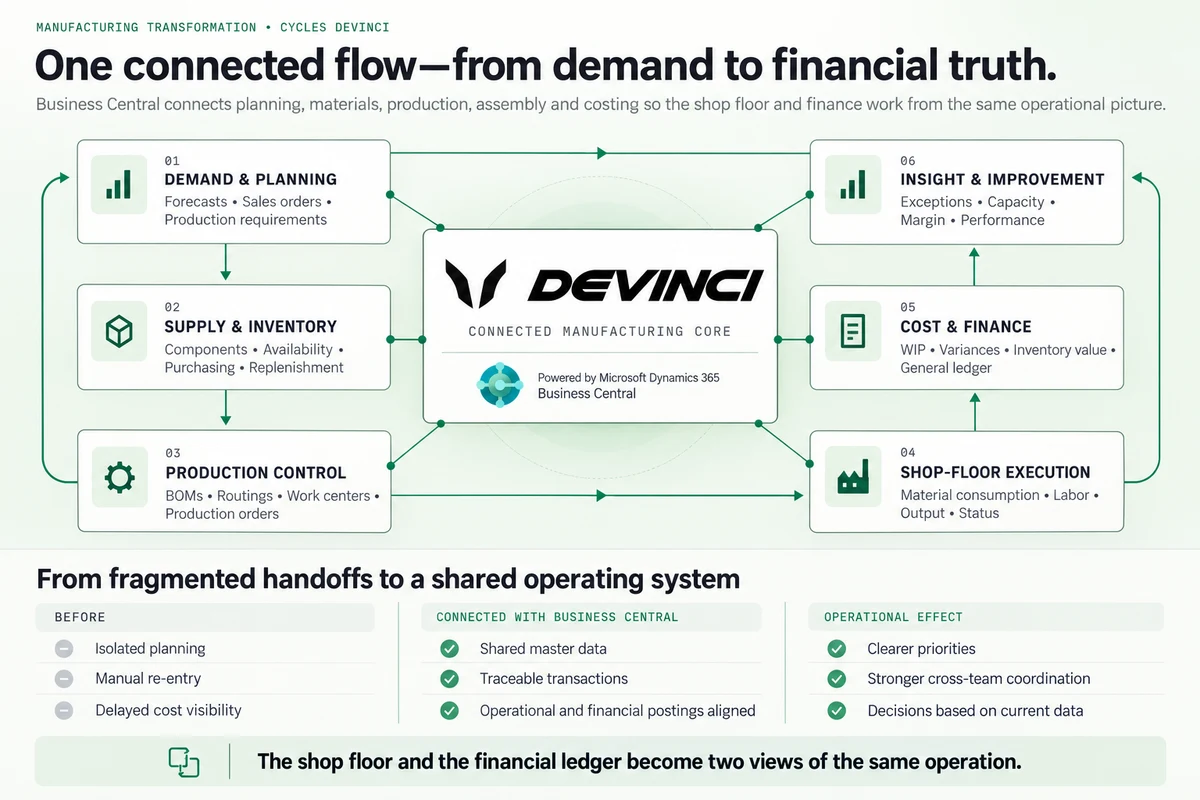
The turning point was a practical route from requirements to production, with priorities, effort, and remaining work kept visible.
One bounded engagement, from discovery to live production.
More at stake than a technology budget.
For a manufacturer, an ERP program draws on far more than its technology budget. Planners, operations leaders, supervisors, and internal specialists invest time in explaining processes, reviewing designs, and preparing for change. When that effort continues without reaching live operation, another implementation commitment becomes harder to make.
Devinci had already selected Business Central as its operational foundation. It needed a partner who could understand manufacturing, assess the work ahead, and turn the platform into something its people could use. Its priorities were explicit: deep Business Central knowledge, manufacturing experience, rigorous project management, and a preference for configuration and process improvement before custom development.
OnTarget’s task was to make the next investment count.
A practical path through ERP recovery
Our recovery work starts with the operation: review the current system, identify what prevents daily use, and agree on priorities, responsibilities and acceptance criteria before the next implementation stage.
Begin with what the factory needs to accomplish.
OnTarget began with the operation. Factory discussions and process documentation examined how work was planned, how material moved, what operators needed at each stage, and how supervisors and quality teams participated.
That established a practical basis for design. Planning needed to support decisions about what could be built. Shop-floor activity needed to stay connected to production orders. Product identification, component recording, and quality checks needed to fit the work being performed.
Configuration vs. tailored development
This level of understanding helped distinguish requirements that could be addressed through Business Central configuration from those that justified tailored development. The resulting approach combined the platform’s manufacturing capabilities with a shop-floor application shaped around Devinci’s operation.
Avoid the traps that make ERP projects expensive.
The recovery addressed several familiar implementation risks. These choices gave the project a practical way to surface issues, make decisions, and direct effort toward operational use.
Developing before the process is clear
Discovery and process review gave the team a business context for configuration and development decisions. Each element needed a purpose in the operation.
Making operators work around the software
The shop-floor design brought relevant activities into a guided sequence, with interactions suited to operators and supervisors.
Treating departments as separate implementations
Planning, production, quality, and warehouse processes were considered together, including the handoffs between them.
Losing sight of the effort still required
Work categories, estimates, and regular reviews helped the teams discuss progress and remaining priorities.
Treating go-live as the end of the engagement
OnTarget stayed involved as users encountered real operating conditions and the environment needed further adjustment.
Keep investment tied to the work that matters.
The recovery needed a clear economic rationale. Devinci was committing further investment after a long and expensive earlier effort. The mandate therefore called for a focused scope and a much tighter budget than the approach previously pursued.
OnTarget and Devinci organized the work around identifiable manufacturing requirements and implementation activities. Progress and remaining effort were reviewed against those categories, giving the business a basis for deciding what to prioritize next.
Budget control came through visibility and decisions: understand the work, estimate what remained, review changes, and keep the next commitment connected to an operational objective.
That discipline supported the move into live production under a constrained recovery mandate. It also kept stabilization and additional work visible as the engagement progressed.
Give the factory floor a usable workflow.
The tailored shop-floor application was central to the engagement. Its design organized activities around the production order and the operator’s task. Product identification, applicable quality checks, component recording, and completion were brought into a guided sequence.
Role-based interactions reflected the different responsibilities of operators and supervisors. Relevant production information and work instructions formed part of the design. For the business, the purpose was straightforward: make Business Central usable where manufacturing work happens.
Development and testing then gave Devinci opportunities to review that experience and refine it before broader use. The workflow was shaped through the combination of manufacturing knowledge, platform expertise, and user feedback.
Connect production to the operation around it.
A shop-floor application needs to function within the wider manufacturing environment. OnTarget addressed the relationships between planning, material availability, production activity, and warehouse processes — including the handoffs that can otherwise become gaps between teams.
Test for the working day ahead.
Preparing for launch meant reviewing how the business would actually operate. OnTarget and Devinci worked through configuration, data, user activities, testing, and support responsibilities. Readiness discussions covered everyday transactions and the practical tools people would use. Realistic testing helped the teams examine the process as a whole, and regular coordination provided a way to review priorities, clarify ownership, and work through the next requirements for launch.
The same principle carried into go-live: the operating environment needed attention as people began using it in production.

The main process working in live production.
Devinci brought its main shop-floor workflow into live use. During the initial post-launch review, the client reported that the main process was working well. Warehouse operations also received positive feedback, while specific cases continued to be investigated and adjusted.
That is the central result of the story: a program that had struggled to reach its operational objective progressed to a working core process on the factory floor.
OnTarget continued supporting the transition. Users needed experience with planning recommendations, operators encountered day-to-day production scenarios, and the teams worked through refinements. Live operation was a substantial milestone, followed by further stabilization and improvement.
Support through the transition to daily use
We connect configuration and testing with role-based training and post-launch support. The transition plan defines how users raise issues, how priorities are reviewed and who owns the next action.
A partner’s value becomes clear in the decisions.
Devinci’s experience shows why manufacturing understanding and delivery discipline matter when selecting a Business Central partner. The important decisions began before development: understand the operation, define the priorities, and choose where configuration or tailored work would serve the business.
They continued through the engagement: keep effort visible, test real workflows, and stay involved as the system entered daily use. For Devinci, that approach helped turn a prolonged implementation effort into a live shop-floor process with a focused recovery investment.
For a manufacturer evaluating its next ERP commitment, it offers a concrete example of the work OnTarget brings to an engagement.
Find the expertise behind the client experience.
Explore the production, costing and inventory capabilities behind manufacturing projects.
See how discovery, validation and stabilization fit into a delivery plan.
Talk to OnTarget about your Business Central project.
Whether you are choosing an implementation partner or reassessing a project already underway, start with the operational outcome you need and the work required to reach it. OnTarget can help you examine your manufacturing workflows, assess the current environment, and define a practical path forward. Bring the process you need to make work — we will start there.